
In Italy, renewables are no longer a niche sector: they now cover about 20% of gross final energy consumption and nearly 40% of electricity consumption, with a further jump in 2024, when clean sources met more than 41% of national electricity demand.
The transition, however, is still far from Europe's 2030 goals and is increasingly shifting to solutions that integrate energy and land. Prominent among these are agri-voltaic (or agro-voltaic) installations, which are the focus of new MASE guidelines and dedicated operating rules.
The picture of renewables in Italy “to date”
According to official indicators, in 2023 the share of energy from renewable sources in Italy's gross final consumption stood at 19.6%, up but still well below the target of 38.7% set by the National Integrated Energy and Climate Plan (NIPEC) at 2030.
On the electricity sector alone, the picture is more advanced:
- In 2023, renewables covered about 37% of gross domestic electricity consumption;
- by 2024, thanks to a strong increase in photovoltaics and wind power (more than 6-7 GW added in one year), renewables reached about 41% of electricity demand, accounting for nearly half of the total generated.
The main supply chains already in operation
In the Italian renewables mix today we find:
- Hydroelectric - It is the historical pillar of the national renewable system. It remains the leading renewable source for electricity production, but has limited room for growth due to environmental and water availability constraints.
- Photovoltaic - It is the engine of recent growth: thanks to utility-scale installations and residential deployment, it has seen record increases in installed capacity in recent years, thanks in part to Superbonuses, energy communities, and widespread self-consumption.
- Onshore wind power - It is growing less quickly than planned, due to permitting complexities and local opposition, but it accounts for an important share of renewable generation, especially in the South Central regions.
- Bioenergy (biomass, biogas, biomethane) - They play a significant role mainly in thermal and some industrial and agricultural segments, as well as in transportation through biofuels and biomethane fed into the grid.
- Geothermal energy - A well-established supply chain but concentrated in a few areas (Tuscany primarily), with further potential especially for low-enthalpy applications in heating/cooling.
- Heat pumps and solar thermal - They fuel the renewable component in the thermal sector, which is gradually growing especially in the residential and tertiary sectors.
Alongside these mature technologies, institutional attention is shifting to solutions that combine energy production, agricultural soil protection and climate adaptation. This is where agrivoltaics comes in.
What is agrivoltaics and why it interests Italy so much
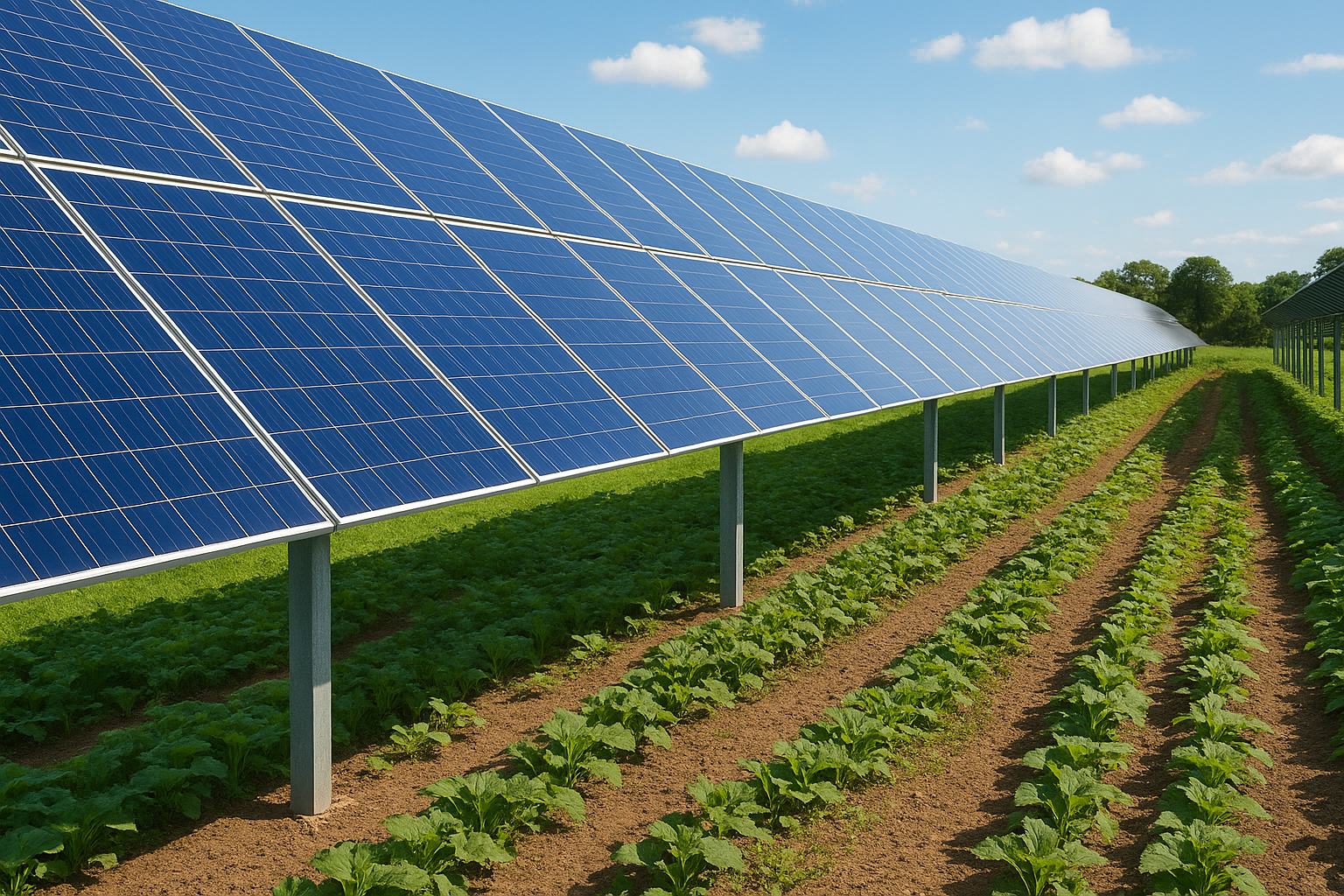
For the ministry (formerly MITE, now MASE), a agrivoltaic system is a photovoltaic system that adopts solutions to preserve the continuity of agricultural and pastoral cultivation activities at the installation site.
The 2022 guidelines distinguish three main levels:
- “Simple” agrivoltaic system”
- Photovoltaics installed in a way that still allows cultivation or grazing.
- Not necessarily equipped with advanced technology, but designed not to take land out of agricultural use.
- Advanced agrivoltaic system
- Photovoltaic modules elevated from the ground, often on mobile structures or trackers, to allow machinery and agricultural activities to pass under the panels.
- Integration of precision agriculture tools and monitoring systems (microclimate, agricultural productivity, water conservation, soil fertility).
- Advanced agrivoltaic system
- It is not just the electrical system, but a complex system that integrates agricultural activity and electrical production in a design way, enhancing the production potential of both “subsystems.”.
The key parameters of the MASE/MITE Guidelines (June 2022).
The Guidelines on Agri-Voltaic Installations (June 2022) set a number of technical and agronomic requirements. In summary:
- Prevailing agricultural land use
- At least the 70% of the surface of the agri-voltaic system must remain devoted to actual agricultural or pastoral activity.
- The parameter LAOR (Land Area Occupation Ratio)., which limits the portion of land actually occupied by PV structures (typically no more than 40%).
- Dual objective: agronomic and energy
- Agricultural production under the facility must remain within a certain threshold compared to the previous situation (or compared to a control area).
- The specific electrical output of the agrivoltaic system must not fall below the 60% than that of a “standard” reference PV system.
- Spatial integration and module height
- Modules raised to allow passage of farm and livestock vehicles: indicative, ≥ 2,1 m for crops with use of machines and ≥ 1,3 m For livestock activity.
- Configurations that can include sloping or vertical panels, also used as protection from excessive radiation, hail and wind.
- Continuous monitoring
- Mandatory monitoring systems for: agricultural production, water consumption and savings, microclimate, energy productivity.
- In “advanced” systems, monitoring must also consider soil fertility and resilience to climate change.
In practice, agrivoltaics is not “extra photovoltaics” on fields, but a model that seeks to numerically demonstrate that the land continues to produce agricultural income while adding a source of energy income.
The government's attention has taken the form of the MASE Decree Dec. 22, 2023, No. 436 (“Agri-Voltaic Decree”), which implements Investment 1.1 “Agri-Voltaic Development” of the NRP.
The potential of projects with agrivoltaics
- Double income for farms: agricultural income + energy income, with greater resilience against agricultural and climate price volatility.
- Climate Adaptation: controlled shading, reduced soil temperature, lower water stress, and the possibility of integrating more efficient irrigation systems.
- Efficient land use: solar energy does not “consume” agricultural land but shares it, meeting measurable parameters (70% agricultural area, LAOR, minimum productivity).
In Conclusion, agrivoltaics as a test case for the Italian transition
The overall picture says two things:
- Italy lags behind the overall renewable targets, especially when looking at gross final consumption: the 19.6% in 2023 is still far from the 38.7% in 2030.
- On the electrical front and in particular On photovoltaics, the growth is very rapid, with renewables covering more than 41% of national electricity demand in 2024.
In this scenario, agrivoltage represents:
- one technology-bridge Between agricultural and energy policies;
- a regulatory laboratory, where innovative criteria are being tested (agronomic monitoring, indicators such as LAOR, minimum thresholds of agricultural and electrical productivity);
- a governance test between the state, regions, environmental authorities and the agricultural world.

 Italiano
  English
  Español