
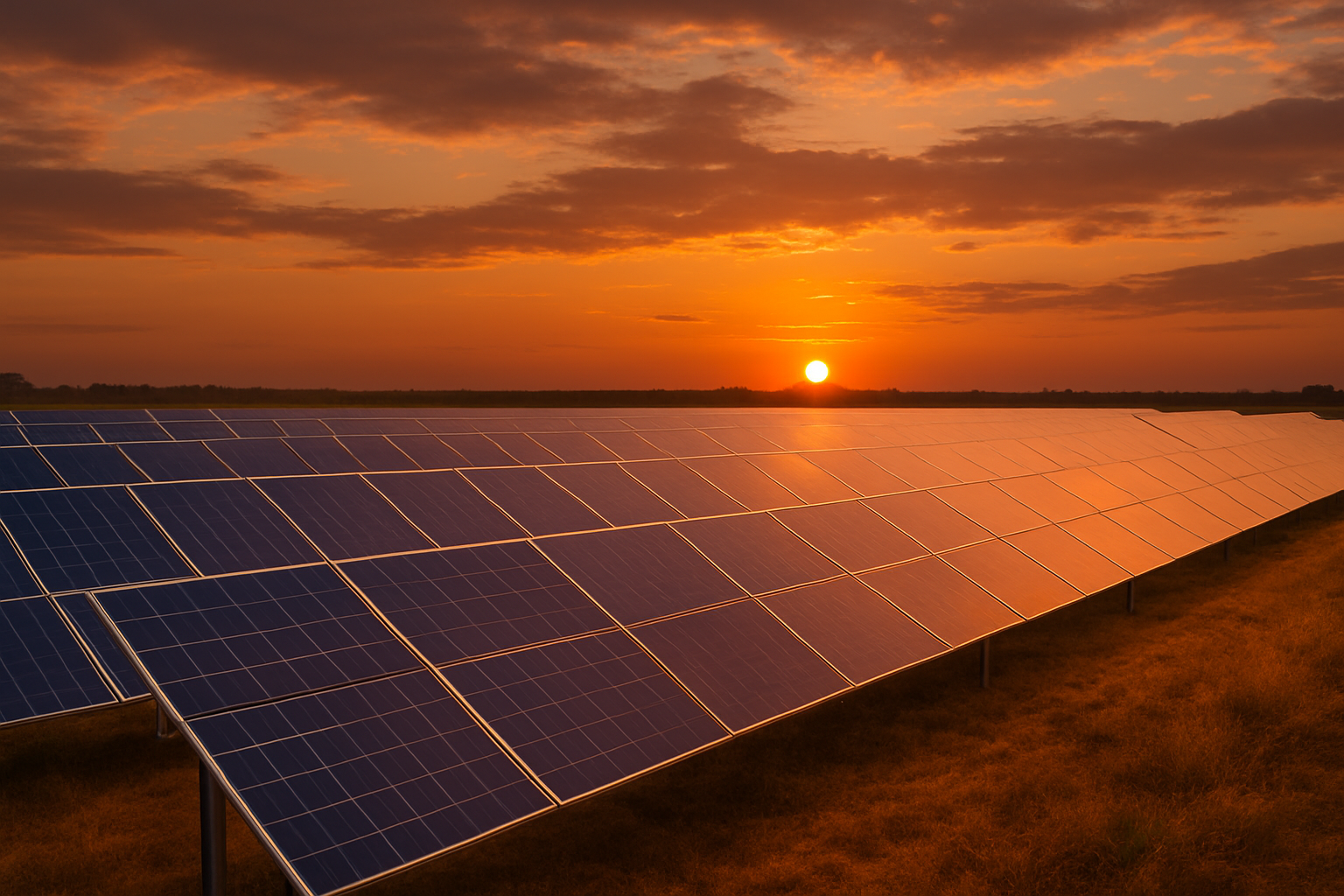
Italy is racing toward more sustainable energy production and, in doing so, faces a crossroads that is not a conflict but a choice of balance: focus on traditional photovoltaics or integrate energy and agriculture through agrivoltaics. Two models that share solar technology but interpret space, landscape impact and land function differently.
Photovoltaics traditional is the most popular solution today. It was created to maximize electricity production and does so through very compact ground-mounted installations, often built on flat surfaces, or on the roofs of residential and industrial buildings. It is the formula that has enabled rapid growth in renewables in recent years because of its efficiency, relatively low cost, and simpler technical process than other technologies. In contrast, ground-mounted installations take land out of agricultural use and markedly alter the rural landscape, an issue that is increasingly debated especially in regions with a strong agricultural focus.
The agrivoltaic Instead, it was born to respond to this very tension. The principle is that of dual land use: producing energy without giving up cultivation. Panels are installed on raised structures, with heights that allow machinery to pass through and agricultural activities to be maintained. Crops are grown under or between the rows of modules, while monitoring systems measure the progress of agricultural production and the microclimate generated by shading. In some cases, the presence of the panels can reduce plant water stress and protect the soil from extreme weather phenomena, turning the plant into a tool for adaptation as well as energy production.
On a practical level, photovoltaics and agrivoltaics respond to different needs. The first is ideal when the main objective is to obtain a lot of energy in the smallest possible space, especially on rooftops, marginal areas or land not used for agriculture for example it is perfect in industrial areas. On the other hand, the second finds application in farms that want to integrate technology and crops while maintaining soil productivity. Ministerial guidelines stipulate that much of the agricultural land remains usable and that production is monitored over time, ensuring that farming does not become an ancillary element but remains central.
However, there is no shortage of critical issues. Agri-voltaics require more complex facilities, larger initial investments and careful agronomic planning. Permitting processes can also be more complex, as they involve assessments of agricultural, landscape and environmental compatibility. On the other hand, the same model brings with it an advantage that traditional photovoltaics cannot offer: the possibility for agricultural enterprises to generate a dual source of income, energy and production, without giving up the vocation of the land.
Thus, the real difference between the two solutions lies in the relationship with the land. Traditional photovoltaics tends to occupy it; agrivoltaics tries to share it. Both contribute to the energy transition, but do so in different ways. The choice between one and the other depends on context, environmental goals, and the need to protect an agricultural sector that is now as much an asset as a strategic resource.
Looking forward, the coexistence of the two technologies appears not only possible but necessary. Italy needs much more renewable energy, but it also has the task of preserving its territories. Agrivoltaics offers a hybrid model that tries to bring these needs together, while traditional photovoltaics will continue to drive solar production. The challenge will be to find the right balance between efficiency, soil conservation and social acceptability, so that the ecological transition is not just a technical issue, but a conscious choice for sustainable development.

 Italiano
  English
  Español